
Byline: KCDW Lead Editorial Writer Linda Willet
“Leadership in Times of Uncertainty” was the title of a speech delivered by Scott Pelley at Illinois State University in Normal, Illinois, on October 27, 2026. For years, many of us watched Scott Pelley on “60 Minutes” every Sunday evening as he introduced us to significant events happening throughout the world and people who were making an impact on others.
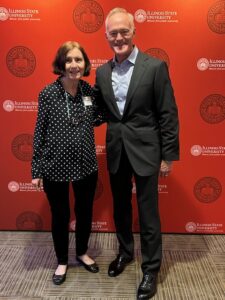
I was fortunate enough to be in the audience that evening as Scott Pelley mentioned three of the most important leaders he had ever met, and I would venture to say that many of us felt that we were on a “60 Minutes” adventure with him as we looked at the photos and heard the stories of these three brave and dedicated people who rose to the occasion and put the needs of millions of others before themselves.
Here is what I learned that evening. Mr. Pelley began by saying that over the years, he has observed many leaders in difficult situations. and he believes that to be a good leader, you need three important characteristics: good values, perseverance, and courage. And when a crisis comes, that leader will inevitably look in the mirror and ask two important questions? Who am I and what is the meaning of life? In other words, “Why am I here?”
The three leaders that Pelley talked about all faced that question, and Scott Pelley said that the most impressive leader he had ever met was President Volodymyr Zelensky, the President of Ukraine. Pelley was in the presidential palace with Zelensky on Feb. 24, 2022, the first day of the Russian attack on Ukraine, and Pelley compared Zelensky’s courage to that of David when he went out to fight Goliath. Pelley said that Zelensky, who had been a comedian, had no preparation for leading a country through a war, and at that time, Ukraine was not prepared to fight a war. On the first day of the war, Zelensky was communicating with his soldiers by cellphone, and Putin was convinced that Zelensky would desert and go to Poland and that Russia could take over the country easily. But Zelensky surprised Russia. As Ukrainians waited, Zelensky went on TV to give an inspiring speech to the nation. He said, “I am still here. Our army is still here, and we are going to fight.” His words galvanized the nation to fight, and he offered weapons to all citizens who wanted to fight for their country along with their president. And to this day, Zelensky is still inspiring his people to fight alongside him and never give up.
The second leader was a young Iraqi woman, Nadia Murad, who was a 21-year-old college student in 2014 when Isis attacked her hometown, killed all the men, raped the women, and sold many of the women, including Nadia into sexual slavery. After three months, Nadia escaped her captors and with the help of a family in the area found her way to a refugee camp out of ISIS territory. While Nadia was in the camp, Pelley’s assistant talked to her and asked her to tell her story. Nadia agreed, but she had three conditions: she would wear a face covering and not reveal her name, all the men except Pelley would leave the room, and the assistant would hold her hand.
Mr. Pelley said that Nadia was shaking so badly that he told her they shouldn’t do the interview, but she said that she wanted to tell her story. And her courage helped others. After seeing the interview, a Belgian newspaper interviewed Nadia, and because of that story, she was one of 1,000 women to become part of a refugee program in Baden-Wurttemberg, Germany, where she lives today. Leaders at the United Nations also saw the 60 Minutes interview and asked Nadia to speak about human trafficking and conflict to the U.N. Security Council on December 16, 2015. And in 2016, she became the first UNODC Goodwill Ambassador for the Dignity of Survivors of Human Trafficking where she advocates for victims around the world. Two years later, in 2018, Nadia Murad and Denis Mukwege were awarded the Nobel Peace Prize “for their efforts to end the use of sexual violence as a weapon of war and armed conflict.” Who would have thought that this traumatized young woman would go on in spite of unbelievable tragedy to help others and educate leaders throughout the world.
And the last hero is a man we may have heard about before. The 9/11 broadcasts told us the stories of brave firemen who ran back into the South tower to save civilians after the tower had partially collapsed. One of those heroes was Orio Palmer, the FDNY Battalion 7 Chief, who took a team of firemen into the South Tower with him. They climbed from the 40th to the 78th Floor, with heavy equipment on their back. There they found traumatized people who were trapped and injured. Orio was calm as he freed people trapped in an elevator, made plans to get everyone to safety, and reported by radio what was happening. Minutes after his call, the tower completely collapsed, killing everyone inside. Orio left behind a wife who was partially blind and three small children, but he didn’t hesitate that day to persevere in spite of danger and courageously put the needs of others before himself.
Needless to say, many of us had tears in our eyes by this time, but Pelley went on to talk about the importance of a free press, which is the public’s right. He said that the founders knew there could not be a democracy without freedom of the press and an independent media. James Madison said that “Freedom of the press is the right that guarantees all the others.” And Madison introduced the amendments that became the Bill of Rights, making it clear that “Congress shall make no law … abridging the freedom of speech, or of the press.”
For the aspiring reporters in the audience, Pelley talked about the characteristics needed to be a good reporter. Unsurprisingly, some of those are the same characteristics that good leaders have. The most important one is empathy because you have to be able to put yourself into the other person’s shoes to tell their story truthfully and let others see it through their eyes. And empathy breeds character, and character breeds heroism. Pelley said that the opposite of having empathy is being a sociopath. The second characteristic is perseverance, and Pelley shared with the audience his numerous rejections by CBS, and how he kept applying for openings at the station even though they told him not to come back again. Pelly ended the presentation by answering questions from the audience and talking about some of the challenges facing reporters today.
It was an inspiring evening and the best speech I have ever heard. One audience member asked if Pelley had ever considered running for office, and Pelley replied no. I had been thinking about asking the same question because it’s obvious that Pelley is a man of character and courage because he was willing to stand up for the public’s right to a free press even though it cost him his job. Scott Pelley is continuing to inspire audiences as he speaks to audiences throughout the U.S. and serves as a Journalist in Residence at the Columbia Journalism School.