

Following the adoption of the Massachusetts State Constitution, an enslaved woman named “Mum Bett” by her enslaver, Pieter Hogeboom, decided to fight for her freedom. Mum Bett grew up on a plantation in New York with her sister Lizzie in the mid-1700s. She and her sister were given to Hannah Ashley, the enslaver’s daughter, when Hannah married Colonel John Ashley.
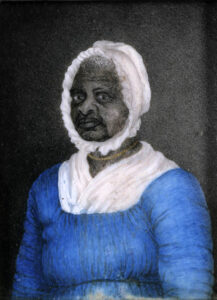
Colonel Ashley was a judge and the moderator of a committee that wrote the Sheffield Declaration, which was approved on January 12, 1773, and stated that “mankind in a state of nature are equal, free, and independent of each other.” Language from that declaration was later used in the Massachusetts Constitution of 1780, which stated that “all men are born free and equal.” It is believed that Bett heard discussions about the Sheffield Declaration while working in the Ashley home, and she may have also heard the declaration read in the public square. Some sources state that she heard a reading of the Declaration of Independence. Even though she could not read or write, Bett believed that the words in the declaration could grant her freedom.
To gain freedom for herself and an enslaved man named Brom, Bett turned to Theodore Sedgwick, a well-known attorney and former Massachusetts delegate to the Continental Congress. Brom was enslaved by Ashley’s son-in-law. Bett knew Sedgwick because he and Colonel Ashley had worked together on the Sheffield Declaration. Sedgwick agreed to take the case even though he knew that Ashley did not want to grant freedom to Bett or Brom. Perhaps Sedgwick felt compassion for Bett because there is documentation that Hannah was often violent with Bett and Lizzie. Or it might have been for legal precedent. History books state that Sedgwick and some other lawyers in the area decided to use the lawsuit as a “test case” to establish whether slavery was constitutional under the new Massachusetts Constitution.
In May 1781, Sedgwick and his team of lawyers filed a “writ of replevin” with the Berkshire Court of Common Pleas, which ordered Colonel Ashley to release Bett and Brom. The court agreed that Bett and Brom must be released, but Colonel Ashely refused to comply. Three months later, Sedgwick filed the case with the County Court of Common Pleas of Great Barrington. He argued that the Constitution’s words “all men are born free and equal” made slavery illegal. The judge agreed and granted freedom to Bett and Brom, awarding each of them 30 shillings and the costs of the trial. Colonel Ashley filed an appeal with the Supreme Judicial Court of Massachusetts but dropped it later. All of Ashley’s slaves, including Bett’s sister Lizzie, were released. And Bett’s and Brom’s case led to the end of slavery in the Commonwealth of Massachusetts in 1783 with dozens of other enslaved people being released.
Mum Bett went on to have a happy life. First, she changed her name to Elizabeth Freeman. Then she became a paid worker in Sedgwick’s house while also working as a healer, midwife, and nurse. She took care of the eight Sedgwick children and Sedgwick’s wife who suffered mental illness after losing three children. The two women bonded with each other.
And after working for 20 years, Elizabeth bought a house and barn where she lived and spent time with her children, grandchildren, and great-grandchildren. Her will states that she owned a house, 20 acres, 300 dollars, and other possessions. She died on December 28, 1829, and was buried in the Sedgwick family plot in Stockbridge, Massachusetts. Catharine Sedgwick, one of the Sedgwick daughters who Elizabeth helped to raised, recorded Elizabeth’s life story in a biography written in 1853. That book includes a quote from Elizabeth: “Any time while I was a slave, if one minute’s freedom had been offered to me, and I had been told I must die at the end of that minute, I would have taken it—just to stand one minute on God’s earth a free woman—I would.”
Sources
Feldman, Ella. “How an Enslaved Woman Took Her Freedom to Court,” Smithsonian Magazine. August 29, 2022.
Go the websites below and search for Elizabeth Freeman
National Women’s History Museum
www.womenshistory.org
www.history.com
Massachusetts Women’s History Center
www.mawomenshistory.org