
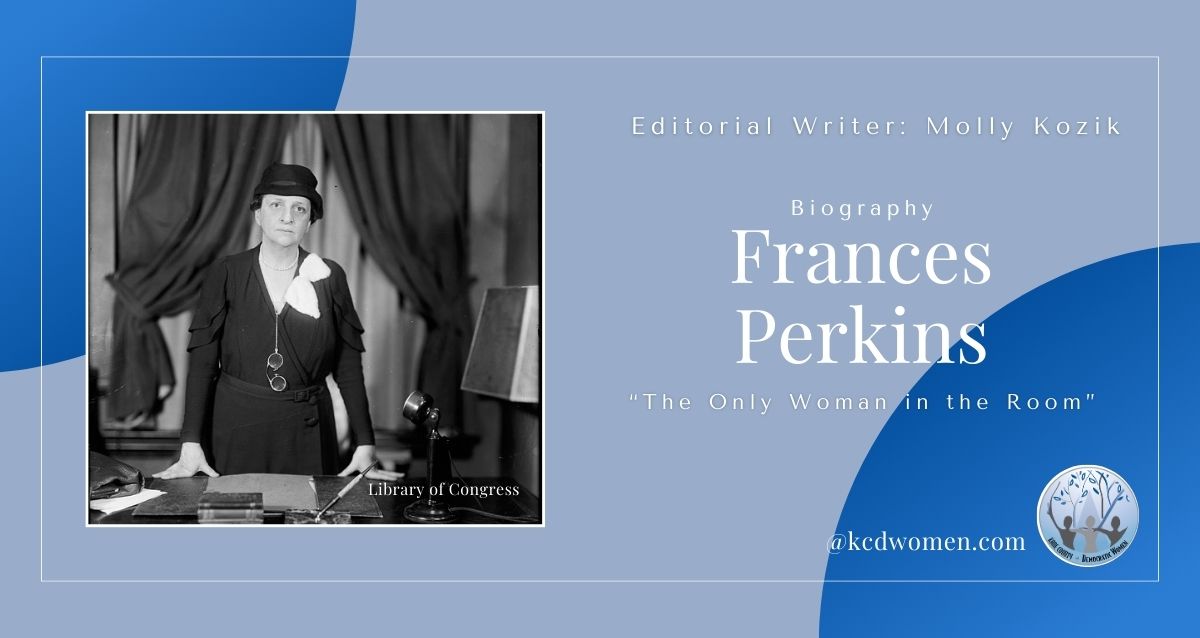
by Editorial Writer Molly Kozik
The 19th Amendment, guaranteeing women’s right to vote, was added to the U.S. Constitution on August 18, 1920. Just 13 years later, Frances Perkins became the first woman to hold a cabinet position in the White House. When President Franklin Roosevelt was sworn in on March 4, 1933, Perkins became his Secretary of Labor.
During her 12 years as Labor Secretary, she played a critical role in workers’ rights that we still hold today—unemployment insurance, child labor regulations, minimum wage, the rights of workers to form unions and Social Security. FDR gets the credit for the Depression Era changes to American lives, but it was Perkins who pushed her progressive agenda through and made the New Deal initiatives law.
This is who Frances Perkins was and why Kane County Democratic Women should know her legacy.
Perkins was born in Boston, Massachusetts on April 10, 1880. She came from a well-to-do family and was encouraged by her parents and her grandmother to make a difference in the world and help people.
She earned her B.A. from Mount Holyoke College in 1902 majoring in chemistry and physics. She became involved in workers’ rights when she toured a factory to study working conditions as part of an economics class in her senior year.
After graduation Perkins briefly taught school in Lake Forest, Illinois and also worked with Jane Addams at Hull House in Chicago.
Perkins returned East to work with women in Philadelphia and then to Columbia University where she earned a master’s degree in sociology and economics in 1910.
Perkins was having tea with friends in New York on March 25, 1911 when they saw a fire begin at the nearby 10-story Triangle Shirtwaist Factory. Frances ran to the scene and witnessed some of the 146 deaths that day as the factory workers were unable to escape the fire. Many of the Jewish and Italian young women garment workers leapt from the 10th floor to escape the flames. Journalist and friend Will Irwin said, “what Frances saw that day started her on her career.”
The poor factory conditions were well-known in the city. Two years earlier 20,000 women factory workers went on strike across New York City to improve pay, working conditions and to help eliminate unsafe and unsanitary work places. Many companies settled with the workers and improved conditions. Triangle did not.
After the Triangle fire, former President Theodore Roosevelt was heading up a committee on New York City workplaces and he placed Perkins at the head of the safety committee. At Perkins’ direction, the committee set up regulations for fire extinguishers, fire drills and water sprinklers.
New York Governor Al Smith noticed the progress Perkins was making on worker safety in the city and named her to a statewide commission that regulated workplaces.
When FDR succeeded Smith as governor in 1929, she continued her activist work and followed FDR to the White House in 1933 as Labor Secretary. Before Perkins said yes to the job she wanted assurances from FDR that he would back her on her progressive agenda for America’s workers.
From the livingnewdeal.org website Perkin’s agenda included: “a 40-hour workweek, a minimum wage, workers’ compensation, a prohibition on child labor, expanded public works projects, social security and health insurance for all–a list she called ‘practical possibilities’. By the end of her long tenure as Secretary, she had accomplished every item on the list except the last.”
Perkins was at the right place at the right time and found a country in need of change and a President willing to take the political risks necessary to help workers and families most in need during the Great Depression.
Personally, Perkins married Paul Wilson in 1913, and had one daughter, Susanna in 1916. Her husband was an economist and a statistician who worked for the City of New York. But Perkins spent much of their marriage as the sole breadwinner. Wilson was institutionalized frequently during their marriage suffering from severe manic depression.
In a series of lectures at UCLA in 1963 Perkins said. “What was the New Deal anyhow?…It was, I think, basically an attitude. An attitude that found voice in expressions like ‘the people are what matter to government’ and ‘a government should aim to give all the people under its jurisdiction the best possible life’.”
Frances Perkins died May 14,1965.
KCDW’s mission is to support and promote local women candidates and get them elected to office. As a group we still see the importance of women having a seat at the table 106 years after getting the right to vote.
I told my political science major daughter that I was writing about Frances Perkins and I wasn’t surprised that I had to explain who she was and what she did. Perkins did not promote herself and she preferred to let her work speak for her. Perkins often worked as the only woman in the room and accomplished these feats when women barely had a voice or a place at the table. More Americans should know her work and more girls should know her name and her legacy.
Bibliography
For Women’s History Month in March, take a look at these books and resources I used to learn about Frances Perkins.
Two children’s books would be good to read and share with younger kids:
Krull, Kathleen. The Only Woman in the Photo. Frances Perkins & Her New Deal for America. Atheneum, 2020.
Hopkinson, Deborah. Thanks to Frances Perkins Fighter for Workers’ Rights. Peachtree Publishing, 2020.
This historical fiction book was excellent to learn about Perkins’ personal life and political life:
Dray, Stephanie. Becoming Madam Secretary. Berkley, 2024.
And here’s two thorough biographies of Perkins and other New Deal leaders in FDRs cabinet:
Downey, Kirstin. The Woman Behind the New Deal The Life and Legacy of Frances Perking—Social Security, Unemployment Insurance and the Minimum Wage. Anchor Books, 2009.
Leebaert, Derek. Unlikely Heroes Franklin Roosevelt, His Four Lieutenants, and The World They Made. St. Martin’s Press, 2023.
Also note a short Frances Perkins bio on the Social Security website:
www.ssa.gov/history/fpbiossa.html
And a section on Frances Perkins in the following website:
livingnewdeal.org